

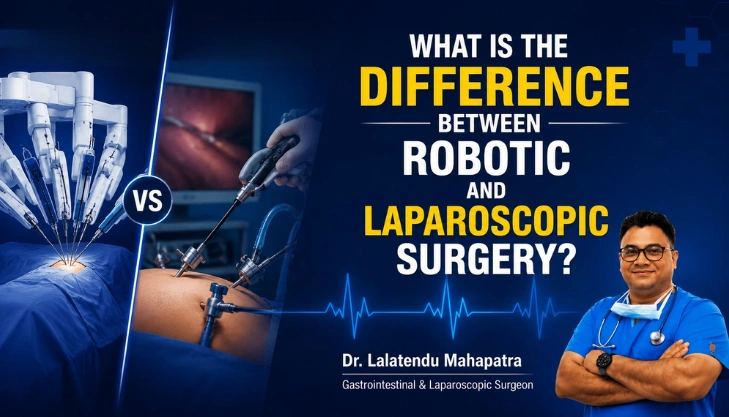
By Dr. Lalatendu Mahapatra | Gastrointestinal, Laparoscopic & Robotic Surgeon, Manipal Hospitals, Bhubaneswar
“Doctor, what is the difference between robotic surgery and laparoscopic surgery?” I hear this question almost every week in our hospitals. Patients come to me confused after reading conflicting things online, and I understand why. Both are minimally invasive surgery techniques, both use small incisions, and both often get lumped together as “keyhole surgery.” But they are not the same, and knowing the difference can help you feel more confident and informed when we sit down to plan your treatment.
In my years of practice as a gastrointestinal surgeon in Bhubaneswar, I have performed both laparoscopic and robotic gastrointestinal surgery and have seen firsthand how each has its own strengths. My goal in this article is simple: to explain both techniques in plain language so you understand what actually happens during your operation and why I may recommend one approach over the other for your specific condition.
What is Laparoscopic Surgery?
Laparoscopic surgery is a minimally invasive gastrointestinal surgery technique where I operate through a few small incisions, usually less than a centimetre each, instead of one large cut. I insert a thin tube with a camera, called a laparoscope, along with long, slender instruments through these incisions. I watch a magnified 2D image of your abdomen on a monitor and move the instruments with my own hands to perform the surgery.
This approach has been the backbone of modern gastrointestinal surgery for over three decades. I use it regularly for gallbladder surgery, hernia surgery, and many colorectal surgery procedures, among others.
What is Robotic Surgery?
Robotic surgery is also a minimally invasive technique, but with one key difference – I control the instruments from a console a few feet away from you, rather than holding them directly. The robotic system translates my hand movements into precise, scaled-down movements of robotic arms inside your body. I see the surgical field in high-definition 3D, magnified many times over, which gives me a much more detailed view than standard laparoscopy.
I want to be very clear about something patients often misunderstand – the robot does not operate on its own. Every single movement is guided by me, in real time. Think of it as an advanced extension of my own hands, offering a steadier, more precise version of what I would otherwise do manually.
Robotic Surgery vs Laparoscopic Surgery – A Detailed Comparison
Patients often ask me to lay out the differences side by side, so here is a comparison table I frequently use during consultations.
| Parameter | Laparoscopic Surgery | Robotic Surgery |
|---|---|---|
| Surgeon Control | Direct hand control of instruments | Console-based control of robotic arms |
| Surgical Precision | High precision, guided by surgeon’s hands | Enhanced precision with tremor filtration |
| Instrument Movement | Limited range, like using long chopsticks | Wrist-like movement, rotates in all directions |
| Visualization | 2D view on a monitor | High-definition 3D view |
| Magnification | Standard magnification | Higher magnification of the surgical field |
| Incision Size | Small, a few millimeters each | Small, similar to laparoscopic incisions |
| Recovery Time | Fast, typically a few days | Fast, often comparable or slightly quicker |
| Blood Loss | Minimal in most cases | Minimal, sometimes lower in complex cases |
| Pain After Surgery | Mild, well-controlled | Mild, often slightly less due to precision |
| Risk of Complications | Low, depends on complexity | Low, may be lower in complex procedures |
| Cosmetic Outcome | Very good, small scars | Very good, similarly small scars |
| Operating Time | Generally shorter | Can be slightly longer due to setup |
| Cost | More affordable | Higher, due to technology and consumables |
| Availability | Widely available | Available at select advanced centres |
Does Robotic Surgery Replace Laparoscopic Surgery?
This is one of the biggest misconceptions I encounter. Robotic surgery does not replace laparoscopic surgery – the two techniques work alongside each other in my practice. The right choice depends on several factors that I evaluate individually for every patient:
- The patient’s specific condition and anatomy
- The complexity of the surgery required
- The patient’s overall health and fitness for surgery
- Surgeon expertise and experience with each technique
- Availability of robotic technology at the treating centre
I often tell my patients that the best surgery is not necessarily the most advanced one, but the one best suited to their condition.
Which Gastrointestinal Procedures Benefit Most from Robotic Surgery?
In my experience, robotic gastrointestinal surgery tends to offer the greatest advantage in procedures that involve complex dissection or fine suturing in confined spaces, such as certain rectal cancer surgeries, complex hernia repairs, and advanced upper gastrointestinal procedures. The enhanced dexterity and 3D vision genuinely make a difference in these situations.
Which Procedures Are Commonly Performed Laparoscopically?
Laparoscopic gastrointestinal surgery remains my first choice for many routine and moderately complex procedures, including gallbladder removal, straightforward hernia surgery, appendectomy, and many colorectal surgery cases. These procedures already achieve excellent outcomes with laparoscopy, and the equipment is more widely accessible.
Benefits Shared by Both Minimally Invasive Approaches
Whether I perform your surgery laparoscopically or robotically, you can expect several shared advantages over traditional open surgery:
- Smaller incisions and better cosmetic outcome
- Less post-operative pain
- Reduced blood loss during surgery
- Shorter hospital stay
- Faster return to normal activities
- Lower risk of wound-related complications
How I Decide the Right Surgical Approach for You
When you consult me, I assess your diagnosis, imaging, overall health, and the complexity of the procedure required. I combine this with my surgical experience in both robotic and laparoscopic gastrointestinal surgery to recommend the approach I believe offers you the safest outcome and the smoothest recovery. I always explain my reasoning so you understand exactly why a particular technique is being suggested for your case.
Questions You Should Ask Your Surgeon
- Which technique do you recommend for my specific condition, and why?
- How much experience do you have with this procedure using this technique?
- What are the expected recovery times for each option?
- Are there any additional costs involved with robotic surgery?
- What are the risks specific to my case?
Frequently Asked Questions
Which is better – robotic surgery or laparoscopic surgery?
Neither is universally better. The right choice depends on your condition, the complexity of the procedure, and your surgeon’s assessment. Both are excellent minimally invasive options.
Is robotic surgery safer than laparoscopic surgery?
Both techniques have excellent safety profiles. Outcomes depend more on surgeon expertise and appropriate patient selection than on the technology used.
Does robotic surgery leave smaller scars?
Both techniques use small incisions and result in minimal, similar scarring in most cases.
Is robotic surgery more expensive?
Yes, robotic surgery generally costs more due to the technology, equipment, and consumables involved.
Who controls the robot during robotic surgery?
I do, entirely. I operate from a console next to you, and every instrument movement is guided by my hands in real time.
Can every laparoscopic surgery be performed robotically?
Technically many can, but it is not always necessary or cost-effective. I recommend robotic surgery when its specific advantages genuinely benefit your case.
Which surgeries benefit most from robotic technology?
Complex procedures requiring fine dissection or suturing in confined spaces, such as certain rectal cancer surgeries and advanced hernia repairs, often benefit the most.
How do I know which option is right for me?
The best way is a detailed consultation, where I review your condition, discuss both options, and recommend the approach best suited to your health and goals.
My Final Thoughts
As a gastrointestinal surgeon in Bhubaneswar, my priority has never been to promote one technology over another. My priority is you – your safety, your comfort, and your long-term outcome. Whether I recommend advanced gastrointestinal surgery through a laparoscopic or a robotic approach, that decision is always guided by what is genuinely best for your specific condition.
Discover More Topics You May Find Helpful:
👉 When is Robotic Surgery Better than Laparoscopic Surgery
👉 Laparoscopic Surgery vs. Robotic Surgery: What’s the Difference
👉 Why More Patients in Bhubaneswar Prefer Laparoscopic Surgery
👉 What to Expect Before and After Laparoscopic Surgery in Bhubaneswar
👉 Things to Know Before Undergoing Laparoscopic Bariatric Surgery

Related Posts

Persistent Acidity After 40: When Could It Be More...
Occasional acidity after a heavy or spicy meal is common. However, Persistent Acidity After 40 deserves closer attention...
Read More
Laparoscopic Weight Loss Surgery in Bhubaneswar: T...
Obesity is more than a concern about body weight or appearance. It is a chronic health condition that can affect blood s...
Read More