

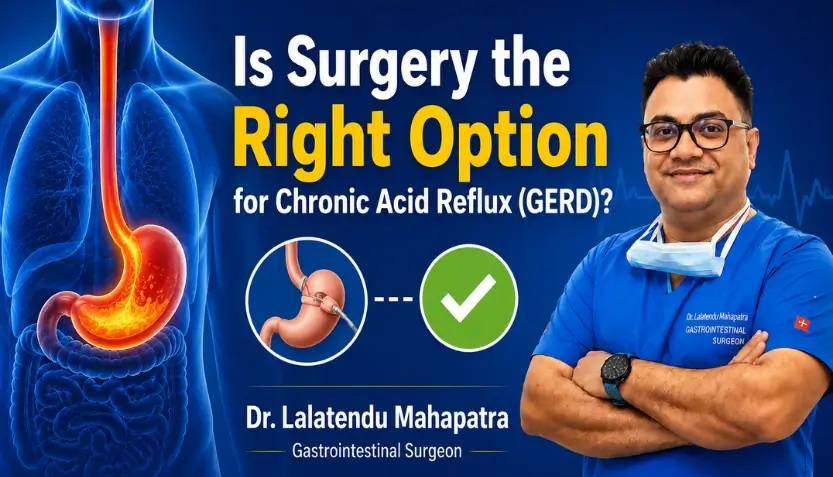
A Complete, Honest Guide by a Surgical Gastroenterologist With 24 Years of Experience
If You Are Still Searching for an Answer, Keep Reading
You’ve probably tried everything. Antacids, PPIs, diet changes, sleeping at an angle. Yet the burning in your chest returns every night. The regurgitation wakes you up. Eating out feels like a risk. You’ve been managing this condition for so long that you’ve started to think it’s simply your new normal.
It doesn’t have to be.
Chronic GERD – Gastroesophageal Reflux Disease – is one of the most mismanaged conditions I see in my 24 years of surgical practice. Not because no solution exists. But because patients are never fully told when medication stops being enough, and what comes next.
This article is my honest, detailed answer to the question I get asked most:
“Doctor, I have been on acid tablets for years and nothing works. Is surgery my only option?” |
Surgery is not always the only option – but for many patients, it is the most permanent, life-changing one. Let me walk you through exactly when, why, and how.
What Is Chronic GERD? (And Why Your Acidity Is Different from Ordinary Heartburn)
GERD – known in India commonly as chronic acidity, gas problem, or heartburn – is not occasional indigestion. It is a structural mechanical failure. Here is the exact difference:
| Occasional Acid Reflux | Chronic GERD |
|---|---|
| Happens once in a while – after a heavy or spicy meal | Occurs 2 or more times per week consistently |
| Relieved easily by antacids | Persists or returns despite medication |
| No structural damage | Causes inflammation, ulcers, or changes to the esophagus |
| No underlying physical defect | Often associated with hiatal hernia or weakened LES |
| No cancer risk | Long-term GERD can progress to Barrett’s esophagus and cancer |
What Actually Causes Chronic GERD?
The root cause is a faulty valve – the Lower Esophageal Sphincter (LES). This muscular ring sits at the junction of your food pipe (esophagus) and stomach. In a healthy person, it opens to let food pass and then snaps tightly shut. In GERD patients, the valve is either weak, loose, or structurally displaced – as happens in a hiatal hernia.
Medications reduce the acid content in what refluxes. They do not fix the valve. This is the single most important reason why some patients will never achieve permanent relief on tablets alone.
GERD Symptoms That Patients in Bhubaneswar Often Normalise
In my surgical practice at Manipal Hospitals Bhubaneswar, I regularly see patients who have been living with these symptoms for 5 to 10 years without seeking specialist surgical evaluation:
- Burning chest pain, especially after meals or when lying down (heartburn)
- Acid or food coming back up into the mouth (regurgitation)
- Difficulty or pain while swallowing (dysphagia)
- Chronic dry cough or throat clearing – often misdiagnosed as asthma
- Hoarse voice or sore throat in the morning
- Waking up at night choking or with a burning sensation
- Dental erosion or a persistent sour taste in the mouth
- Frequent belching, bloating, and upper abdominal discomfort
Warning: When GERD Becomes DangerousLeft untreated for years, chronic GERD can progress to:
Barrett’s esophagus is found in approximately 10–15% of patients with long-standing GERD. Early surgical intervention can stop this progression entirely. |
Why Your Acid Tablets Are No Longer Enough
Proton Pump Inhibitors PPIs like omeprazole, pantoprazole, and rabeprazole are the most prescribed medications for GERD in India. For mild or moderate GERD, they work well. But for severe or structural GERD, they have a fundamental limitation:
The Core Problem with PPIs
The moment you stop PPIs, symptoms return – because the underlying structural problem still exists. |
Medication manages your symptoms. Surgery corrects your anatomy.
7 Clear Signs You Should Consider GERD Surgery
Based on clinical guidelines and 24 years of experience, here are the specific conditions under which surgery is not just an option – it is the medically superior choice:
1. PPIs for 3+ Years With Incomplete Relief:
If you are still experiencing breakthrough heartburn, regurgitation, or sleep disruption despite taking PPIs daily, your condition has a structural cause that tablets cannot fix. You should be evaluated by a surgical gastroenterologist – not given a higher PPI dose.
2. Confirmed Hiatal Hernia:
A hiatal hernia – No medication can push your stomach back through the diaphragm. Surgery is the only correction. Our detailed guide on hernia surgery – causes, symptoms, types and laparoscopic treatment explains how laparoscopic hernia repair works and what patients can expect.
3. Barrett’s Esophagus or Grade III-IV Esophagitis:
Once the esophageal lining shows precancerous changes (Barrett’s esophagus) or severe erosive esophagitis, surgical elimination of reflux is a medically critical step. At this stage, surgery is not about comfort – it is about cancer prevention.
4. Side Effects from Long-Term PPIs:
Bone density loss, B12 deficiency, or kidney stress from years of medication? Surgery can get you off tablets permanently.
5. You Are Young and Want a Permanent Solution:
A 35-year-old starting PPIs faces 40+ years of daily medication. One laparoscopic procedure can change that.
6. Your Symptoms Are Causing Serious Quality-of-Life Impairment:
If GERD is disrupting your sleep, diet, work, or social life – that is a fully valid clinical reason for surgery.
7. Large-Volume Reflux or Aspiration:
Repeated aspiration pneumonia, chronic cough, or worsening asthma caused by reflux requires surgical correction. Medication is inadequate protection at this stage.
GERD Surgery Options Available in Bhubaneswar: Explained Simply
At our practice in Bhubaneswar, we offer the full spectrum of anti-reflux surgical procedures using laparoscopic and robotic-assisted techniques. Here is a plain-language explanation of each:
1. Laparoscopic Nissen Fundoplication – The Gold Standard
This is the most proven GERD surgery in the world and the procedure we perform most frequently. There is a reason more patients in Bhubaneswar now prefer laparoscopic surgery over open procedures – smaller incisions, faster recovery, less pain, and outcomes that match or exceed traditional surgery.
How it works: The upper part of your stomach (the fundus) is wrapped 360 degrees around the lower esophagus, creating a reinforced valve that prevents reflux. Any hiatal hernia is repaired at the same time. 90–95% of patients report significant or complete relief. Over 80% are off PPIs at five years. Hospital stay: 1–2 days.
2. Laparoscopic Toupet Fundoplication – Partial Wrap
A 270° partial wrap recommended for patients with weakened esophageal motility. Provides excellent reflux control with a lower risk of post-operative swallowing difficulty.
3. LINX Magnetic Sphincter Augmentation
A small bracelet of magnetised titanium beads placed around the LES laparoscopically. Keeps the sphincter closed at rest but allows normal swallowing. Best suited for mild to moderate GERD. Faster recovery than fundoplication.
4. Robotic-Assisted Anti-Reflux Surgery
For complex cases – large hiatal hernias, redo surgeries, or obese patients – robotic assistance provides 3D magnified visualisation and tremor-free precision where standard laparoscopy has limitations.
Surgical Options at a Glance:
| Procedure | Best For | Approach | Hospital Stay | Recovery |
|---|---|---|---|---|
| Nissen Fundoplication | Most GERD + hiatal hernia patients | Laparoscopic | 1-2 days | 7-14 days |
| Toupet Fundoplication | Weak esophageal motility | Laparoscopic | 1-2 days | 7-14 days |
| LINX Device | Mild-moderate GERD | Laparoscopic | Same day | 5-7 days |
| Robotic Surgery | Complex / redo cases | Robotic-assisted | 1-3 days | 7-14 days |
Before, During, and After GERD Surgery: A Patient’s Complete Guide
Step 1: Pre-Operative Evaluation – We Will Never Operate Without This
Rushing into surgery without proper evaluation is one of the biggest mistakes in GERD management. Before recommending any anti-reflux surgery, we require the following investigations:
1. Upper GI Endoscopy (OGD Scopy) –
To directly assess the esophageal lining, confirm reflux-related damage, identify Barrett’s esophagus, and evaluate the LES.
2. 24-Hour pH Monitoring / pH-Impedance Study –
The gold standard for objectively measuring how much acid is refluxing, for how long, and correlating it with your symptoms.
3. Esophageal Manometry –
Measures the pressure and movement pattern of the esophagus. This determines whether you need a full 360-degree wrap or a partial 270-degree wrap.
4. Barium Swallow Study / CT Scan –
To map the anatomy of the hiatal hernia and plan the surgical repair strategy.
For a detailed patient walkthrough of what the preparation and post-surgery process involves, read our guide on what to expect before and after laparoscopic surgery in Bhubaneswar.
Step 2: The Surgery Itself
- Performed under general anaesthesia in a fully equipped operation theatre
- Duration: 1 to 2 hours for standard laparoscopic fundoplication
- 4 to 5 small keyhole incisions – no large abdominal cut
- Hiatal hernia repaired simultaneously if present
- Most patients are mobile and taking liquids within hours of surgery
Step 3: Recovery Timeline – Week by Week
Recovery from GERD surgery follows a predictable and manageable timeline. For a broader perspective on recovery across different GI procedures, refer to our detailed guide on how long GI surgery recovery takes.
| Timeframe | What to Expect | Diet |
|---|---|---|
| Day 1-2 | Liquid diet, mild discomfort at incision sites, discharge from hospital | Clear liquids only |
| Week 1-2 | Rest at home; some bloating and difficulty swallowing – both expected and temporary | Soft / pureed foods |
| Week 2-4 | Progressive improvement; most desk workers return to work | Semi-solid, soft foods |
| Month 1-3 | Significant symptom improvement; gas and bloating reduce; swallowing normalises | Normal diet, avoid very hard foods |
| 6+ Months | Full resolution of GERD symptoms in most patients; majority off all medication | Unrestricted normal diet |
What About Risks? An Honest Assessment
No surgery is risk-free. In the interest of full transparency, here are the risks you should understand before proceeding:
| Common Temporary Side Effects | Less Common Complications |
|---|---|
| ✓ Difficulty swallowing (dysphagia) in weeks 1-6 – resolves as swelling reduces | • Wrap herniation or slippage – rare; more common with severe obesity |
| ✓ Increased gas and bloating in the first 2-3 months | • Recurrence of GERD over 10+ years in approximately 10-15% of patients |
| ✓ Difficulty belching – usually a sign the valve is working correctly | • Esophageal or gastric injury – extremely rare in experienced surgical hands |
| ✓ Mild incision discomfort for 1-2 weeks | • Conversion to open surgery – very rare; undertaken for patient safety when needed |
With over 6,000 surgeries performed across 24 years of practice in Bhubaneswar, Odisha – including advanced laparoscopic and robotic procedures – our practice maintains an excellent safety record. Thorough pre-operative evaluation is the cornerstone of our risk-reduction approach.
Surgery vs. Lifelong Medication: How to Make the Right Decision
This is a decision that deserves honest reflection – not pressure in either direction. Here is the framework I use with every patient at my Bhubaneswar clinic:
| Surgery Is Likely the Right Choice If… | Continue Medication If… |
|---|---|
| ✓ Symptoms persist on optimal PPI therapy | • Symptoms are well-controlled on low-dose medication with no side effects |
| ✓ You have a confirmed hiatal hernia on endoscopy or CT | • No structural defect found on thorough investigation |
| ✓ Barrett’s esophagus or Grade III-IV esophagitis is present | • GERD is mild, infrequent, and responds well to lifestyle changes |
| ✓ You have been on PPIs for 3+ years and want to stop | • You have significant co-morbidities that increase surgical risk |
| ✓ You are under 60, healthy, and want a permanent solution | • Recent-onset GERD – lifestyle changes and a medication trial have not been fully attempted |
| ✓ Side effects from long-term PPIs are affecting your health | • You have a strong personal preference to avoid surgery |
| ✓ Large-volume reflux is causing aspiration, cough, or asthma worsening | • Symptoms began after a temporary trigger such as pregnancy or short-term stress |
Your Top 8 Questions About GERD Surgery – Answered
These are the questions that appear most frequently in searches and in my consultation room in Bhubaneswar. I have answered every one of them directly and honestly.
Q1. Is GERD surgery permanent? Will it last for life?
Laparoscopic fundoplication provides long-term relief in over 90% of patients. At five years, more than 80% of patients are completely off all acid-suppressing medication. At ten years, approximately 85-90% remain symptom-free. A small percentage – roughly 10-15% – may experience symptom recurrence over a decade, often related to significant weight gain or persistent forceful vomiting. Redo surgery is possible in carefully selected cases. No surgical procedure carries a lifetime guarantee, but fundoplication comes closest for most patients.
Q2. What is the cost of GERD surgery (fundoplication) in Odisha?
Standard laparoscopic fundoplication: ₹1,20,000-₹2,50,000. Robotic-assisted: ₹2,50,000-₹4,00,000. Pre-operative investigations add ₹15,000-₹40,000. At our Bhubaneswar centre, costs are significantly more affordable than metro cities. Most health insurance policies cover this procedure.
Q3. How long is recovery after GERD surgery?
For laparoscopic fundoplication, most patients are discharged within 1 to 2 days. They return to light desk work within 7 to 14 days, and to full normal activity within 4 to 6 weeks. A soft diet for the first month is standard as the wrap settles.
Q5. Will I be able to eat normally after fundoplication surgery?
Yes – the vast majority of patients return to a completely normal diet within 6 to 8 weeks. Eating slowly and chewing thoroughly improves comfort in the early weeks, but these are habits – not permanent restrictions.
Q6. Can GERD be cured without surgery?
For mild GERD without structural problems, lifestyle changes and PPIs provide effective long-term control. However, for patients with a hiatal hernia, Barrett’s esophagus, or persistent symptoms on maximum medication, surgery is the only option that corrects the underlying physical problem.
Q7. Is GERD surgery safe? What are the risks?
Yes – laparoscopic fundoplication is one of the most extensively studied minimally invasive procedures in the world and is considered safe in experienced hands. The most common side effects – temporary difficulty swallowing and increased gas – are expected and resolve on their own. Serious complications are rare. The risk of esophageal or gastric injury is extremely low. In our practice in Bhubaneswar, safety begins before the first incision – with rigorous patient selection and thorough pre-operative evaluation.
Q8. I have GERD and I am also overweight. What surgery should I consider?
This is an important question. Obesity is one of the strongest risk factors for GERD – excess abdominal pressure continuously pushes stomach contents upward. For patients with both significant obesity (BMI above 35) and GERD, bariatric surgery – particularly Roux-en-Y Gastric Bypass or Sleeve Gastrectomy – may be a better primary option than fundoplication alone. Gastric Bypass has been shown to dramatically reduce GERD in obese patients.
I am a trained bariatric surgeon with fellowship certification. If you are considering this path, read our guide on things to know before undergoing laparoscopic bariatric surgery for a clear starting point. I evaluate each patient individually to determine which approach serves them best when both conditions are present.
Conclusion: You Deserve to Live Without Acid Reflux
GERD is one of the most common, most disruptive, and most under-treated conditions I encounter at Manipal Hospitals Bhubaneswar – not because solutions do not exist, but because patients are not guided toward them early enough.
If you have been living with chronic acid reflux for years, if your medications have stopped working, if you have developed a hiatal hernia or Barrett’s esophagus – the answer you are looking for may not be in another prescription. It may be a single, minimally invasive procedure that corrects the underlying problem once and allows you to eat, sleep, and live freely again.
Surgery is not the right answer for every GERD patient. But if your case meets the criteria discussed in this article, you owe it to yourself to have an honest, expert conversation about what surgery could do for you.
I have helped thousands of patients in Bhubaneswar, Odisha and across Eastern India make this decision clearly and confidently. I would be glad to do the same for you.
| Book a Consultation for GERD Surgery in Bhubaneswar, Odisha
Dr. Lalatendu Mahapatra – Surgical Gastroenterologist |

Related Posts
Why Patients Prefer Minimally Invasive GI Surgery ...
When GI surgery is recommended, patients often worry about pain, hospital stay, scars, and recovery time. GI surgery in ...
Read More
What is the Difference Between Robotic and Laparos...
By Dr. Lalatendu Mahapatra | Gastrointestinal, Laparoscopic & Robotic Surgeon, Manipal Hospitals, Bhubaneswar “...
Read More