
By Dr. Lalatendu Mahapatra / Gastrointestinal & Laparoscopic Surgeon at Manipal Hospitals Bhubaneswar
Bariatric surgery is one of the most transformative decisions a person can make for their long-term health. After more than two decades and over 6,000 surgeries performed, I can tell you with absolute confidence: the operation itself is just the beginning. What you eat in the weeks, months, and years that follow determines how fully you recover, how much weight you lose, and how well you maintain that result.
This guide is written for you my patients and those considering bariatric surgery so you understand exactly what to expect nutritionally after the procedure. Follow these guidelines carefully, work closely with your care team, and you will give yourself the best possible foundation for a healthier life.
Why Following the Post-Bariatric Diet Is Non-Negotiable
After bariatric surgery, your digestive anatomy is fundamentally altered. Your stomach is significantly smaller – in some procedures, it holds as little as 30 ml initially – and your intestinal absorption may also be modified. This means:
- Eating too much too soon can rupture staple lines or stretch the pouch.
- Eating the wrong textures can block the stoma (the small opening).
- Skipping protein leads to muscle loss, hair thinning, and fatigue.
- Poor fluid intake causes dehydration and kidney stones.
- High-sugar foods trigger Dumping Syndrome – rapid heart rate, sweating, nausea, and diarrhoea.
Respecting this diet is not about restriction. It is about protection – protecting your surgical repair, supporting your healing, and maximising your weight loss results.
For a broader understanding of what recovery looks like after GI surgery, read: How Long Does GI Surgery Recovery Take?
The Post-Bariatric Diet: Phase-by-Phase Breakdown
Every phase in the post-bariatric diet exists for a clear medical reason. Your stomach is healing, adapting, and slowly rebuilding its relationship with food. Do not skip or rush any phase. Moving ahead too soon risks rupturing the staple line, blocking the stoma, or triggering painful complications.
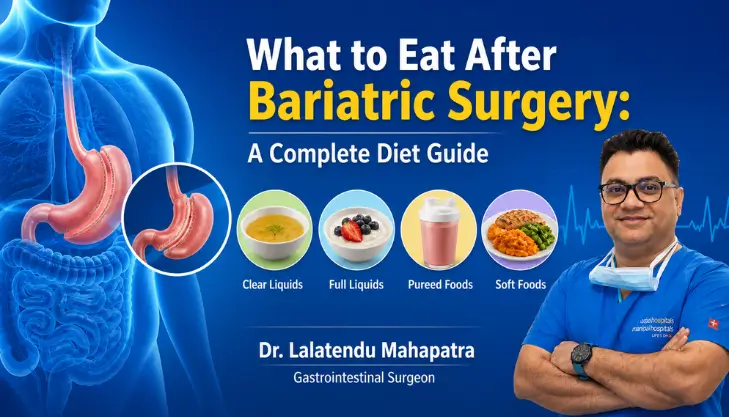
Phase 1: Clear Liquids (Days 1-2 Post-Surgery)
This phase begins immediately after surgery and focuses solely on keeping you hydrated without straining your newly operated stomach.
- Water (sipped slowly – never gulped)
- Clear broth (low sodium, no solids)
- Diluted fruit juice (no pulp)
- Plain coconut water
- Gelatin (sugar-free)
Target: 48-64 oz (1.5-2 litres) of fluids daily. Avoid carbonated drinks completely.
Phase 2: Full Liquids (Weeks 1-2)
As healing progresses, we introduce more nourishing liquids that provide some protein and calories to support tissue repair.
- Protein shakes (whey or plant-based, low sugar)
- Skimmed milk or soy milk
- Smooth, strained dal or lentil soup
- Thinned yogurt (no fruit chunks)
- Blended vegetable soups (no cream)
Goal: At least 60-80 grams of protein per day from liquids. This is non-negotiable for healing.
Phase 3: Pureed & Soft Foods (Weeks 3-6)
Your stomach can now handle soft, blended foods. Introduce these one at a time to monitor tolerance.
- Scrambled eggs or soft-boiled eggs
- Mashed lentils (dal) with minimal spice
- Smooth cottage cheese (paneer blended)
- Pureed chicken or fish
- Soft-cooked vegetables (no skin)
- Banana or papaya (mashed)
Eat slowly. Chew thoroughly. Stop eating the moment you feel full – your pouch communicates differently now.
Phase 4: Solid Foods (Week 7)
By week seven, most patients can transition to a modified solid food diet. However, ‘solid’ does not mean ‘unrestricted.’ Every bite still needs to be intentional.
- Grilled or baked fish and chicken (well-chewed)
- Legumes and lentils (cooked soft)
- Low-fat dairy products
- Cooked vegetables and salads (no raw fibrous greens initially)
- Whole grains in small quantities
Phase 5: Regular Healthy Diet (From Week 8-12 Onwards)
Goal: Establish a lifelong nutritional pattern that supports weight loss and prevents deficiencies.
By 2-3 months post-surgery, most patients transition to what we call their “lifetime diet.” This is not a temporary phase – this is how you will eat for the rest of your life. The principles are:
- Protein First, Always: Start every meal with protein. Eat it completely before any carbs or vegetables. Limited space – use it wisely.
- Eat Small, Eat Frequent: Max ½-1 cup per meal. Your pouch may stretch slightly, but will never be your old stomach.
- Hydrate Between Meals, Never During: 1.5-2 L water daily. Stop fluids 30 min before eating; resume 30–45 min after. Drinking during meals causes dumping syndrome.
- Avoid Empty Calories Completely: Avoid sodas, juices, sweets, fried snacks. Zero nutritional value, spike blood sugar, raise dumping risk.
- Take Your Supplements Every Single Day: Surgery causes permanent malabsorption. Supplements are a medical prescription, not optional. Take them for life.
Doctor’s Note – The Most Common Mistake I See
Patients often feel well by Week 3 and try to jump to normal food. This is the most dangerous period. Your stomach staples are still healing internally even when you feel fine on the outside. Trust the phases. The 8–10 weeks of dietary discipline you invest now directly determines the quality of your results for the next 10 years.
For a detailed overview of what lies ahead after surgery, see: What to Expect Before and After Laparoscopic Surgery in Bhubaneswar.
7-Day Sample Indian Meal Plan (Phase 5 – After Week 8)
The following plan is designed for patients who have successfully progressed through all phases and are now on their lifelong maintenance diet. All portions are small – approximately half a cup to one cup per meal.
|
Important note: This is a general guideline. Your individual meal plan must be tailored based on your surgery type (sleeve, bypass, mini bypass), your current weight, co-morbidities, and your progress. Always consult Dr. Lalatendu Mahapatra or your registered dietitian before making changes.
Essential Supplements After Bariatric Surgery
Bariatric surgery permanently reduces the absorption of several critical nutrients. Nutritional deficiency is not a risk – it is a certainty if you do not take supplements. These are lifelong prescriptions, not optional additions.
|
Critical: Do Not Take Calcium and Iron Together
Calcium and iron compete for absorption. Always take them at least 2 hours apart. A common schedule: calcium in the morning + evening; iron at midday or night. This simple rule prevents both deficiencies simultaneously.
Long-Term Diet: Life After the First Year
After the first year, most patients are stabilising at their new weight. The temptation to “relax” the diet is real – and it is the most common reason for weight regain.
What successful long-term bariatric patients maintain:
- Protein-first eating at every meal – this never changes
- Regular blood tests every 6-12 months to check for nutritional deficiencies
- Lifelong supplements – without exception
- Avoidance of liquid calories – juices, milkshakes, sweetened tea all slip in easily
- Regular follow-up with their bariatric surgeon – at least once a year
- 30-45 minutes of moderate physical activity at least 5 days per week
- Mindful eating habits maintained even at social gatherings, festivals, and travel
To understand what long-term outcomes look like, read about the successful bariatric surgery performed on a 66-year-old woman at Manipal Hospitals Bhubaneswar – a real-world example of what is possible with the right surgical and dietary approach.
Frequently Asked Questions (FAQs)
Q1. Can I eat rice after bariatric surgery?
Yes – but in very small quantities and only after Phase 5. White rice should be limited due to its high glycaemic index (which can cause Dumping Syndrome and slow weight loss). Brown rice or parboiled rice in a 2-3 tablespoon serving is preferable. Always eat protein first, and rice last.
Q2. When can I eat roti or chapati?
Soft roti (one small roti, well-cooked) can typically be introduced in Phase 4 (weeks 6–8). Avoid thick or doughy preparations. Multigrain or wheat flour rotis are better than maida-based items. Tear into small pieces and chew thoroughly.
Q3. Can I drink chai (tea)?
Plain, unsweetened chai or black tea in small quantities is acceptable after the first 3 months. Avoid adding sugar. Avoid very strong tea on an empty stomach. Chai with milk can substitute as a warm, comforting drink, but do not count it as your fluid intake.
Q4. Will I get hungry all the time?
Initially, most patients report reduced hunger – this is normal and related to changes in the hunger hormone ghrelin after surgery. Over time, some hunger returns. Do not ignore hunger signals, but respond with protein-rich, low-sugar foods rather than processed snacks.
Q5. Can I eat out at restaurants?
Yes – with planning. Choose grilled, boiled, or steamed dishes. Avoid fried items, breaded preparations, desserts, and sugary drinks. Many restaurants offer tandoori items, dal, and yoghurt-based dishes that work well. Always carry water and eat protein first.
Q6. Is hair loss normal and can diet help?
Temporary hair loss (telogen effluvium) in months 3-6 post-surgery is common. It is primarily caused by protein deficiency and surgical stress, not by the surgery itself. Meeting your daily protein target of 60–80 g and taking zinc and biotin supplements can significantly reduce hair loss. Hair typically regrows by months 9-12.
Warning Signs: When to Contact Your Surgeon Immediately
- Persistent vomiting – more than 2-3 episodes per day
- Complete inability to tolerate any liquids
- Severe abdominal pain or cramping
- Fever above 38.5°C with abdominal symptoms
- Dizziness, fainting, or extreme weakness
- Signs of dehydration (no urination for 8+ hours, very dark urine)
- Chest pain, rapid heartbeat, or difficulty breathing
- Heavy or unusual bleeding from any site
- Symptoms of severe Dumping Syndrome that do not resolve
From My 24 Years of Experience: Trust the Process
I have seen patients transform their lives completely after bariatric surgery – not just physically, but in their energy, confidence, and quality of life. I have also seen patients struggle when they return to old eating habits. The difference, in every case, comes down to nutrition.
The post-bariatric diet is not a punishment. It is a prescription for a better life. Follow it with the same seriousness that brought you to the operating table, and you will achieve results that genuinely last.
For more expert guidance and information, you can also visit: drlalatendumahapatra.com

Related Posts
Why Patients Prefer Minimally Invasive GI Surgery ...
When GI surgery is recommended, patients often worry about pain, hospital stay, scars, and recovery time. GI surgery in ...
Read More
What is the Difference Between Robotic and Laparos...
By Dr. Lalatendu Mahapatra | Gastrointestinal, Laparoscopic & Robotic Surgeon, Manipal Hospitals, Bhubaneswar “...
Read More