

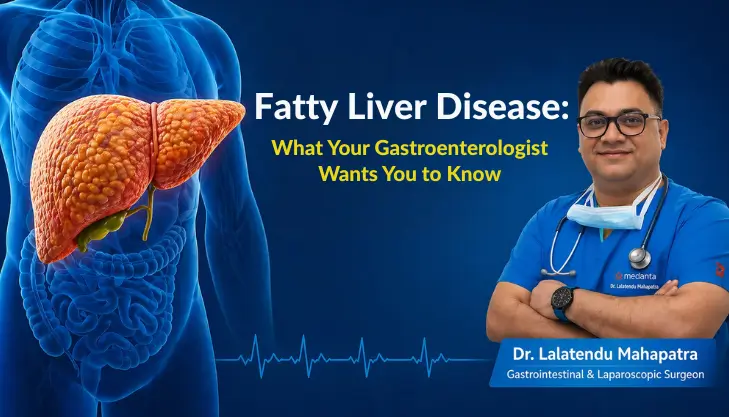
By Dr. Lalatendu Mahapatra / Gastrointestinal & Laparoscopic Surgeon at Manipal Hospitals Bhubaneswar
Every week, patients arrive at my clinic at Manipal Hospitals Bhubaneswar holding an ultrasound report that says “fatty liver” – confused, worried, and often told to simply “eat less oil.” That advice is incomplete. Fatty liver disease is a serious, progressive condition that affects roughly 1 in 4 adults worldwide – and in Odisha, I believe that number is even higher. If you are experiencing common gastrointestinal problems, fatty liver is one of the most frequently overlooked. You deserve a clear, honest explanation of what it is, how dangerous it can become, and what to do about it right now.
What Is Fatty Liver Disease – and Why Is It Spreading?
Fatty liver disease (hepatic steatosis) occurs when excess fat accumulates in liver cells, exceeding 5–10% of the liver’s total weight. There are two forms:
- NAFLD (Non-Alcoholic Fatty Liver Disease): The most common type today. Caused by obesity, insulin resistance, type 2 diabetes, and high triglycerides – not alcohol. This is the one silently rising across Odisha.
- Alcoholic Fatty Liver Disease: Caused by chronic heavy drinking. The liver’s process of breaking down alcohol produces toxic by-products that progressively damage liver cells.
In Odisha, I see NAFLD increasingly in people in their 30s and 40s – desk workers, young mothers, and even teenagers. High-carbohydrate diets, sedentary routines, rising diabetes rates, and metabolic syndrome are fuelling this silently. If you’re unsure whether your symptoms warrant a visit, learn about when to see a GI specialist.
The 4 Stages: Where You Are Determines Everything
Fatty liver is not one fixed condition – it progresses through four stages, and the stage you are at determines how urgently you need to act.
| Stage | Medical Name | What Is Happening | Outlook |
|---|---|---|---|
| Stage 1 | Simple Steatosis | Fat accumulates in liver cells. No inflammation or scarring yet. | Fully reversible with lifestyle changes |
| Stage 2 | NASH | Fat with inflammation. Liver cells begin to get damaged. A critical stage affecting 20–25% of NAFLD patients. | Reversible with medical supervision |
| Stage 3 | Hepatic Fibrosis | Scar tissue replaces healthy liver tissue. Liver function starts declining. | Manageable with aggressive treatment |
| Stage 4 | Cirrhosis / Liver Failure | Severe scarring damages liver structure. Symptoms include jaundice, fluid buildup, and bleeding risk. | Critical stage; liver transplant may be required |
The most important thing I tell every patient:
Stages 1-2 are reversible. Stage 3 is manageable. Stage 4 is a crisis. Every year of delay moves you one step closer to the point of no return.
Who Is at Risk? The Profile I See Most
Fatty liver does not always announce itself with weight or appearance. I have diagnosed it in lean individuals and young professionals who “feel completely fine.” Get evaluated if you have:
- Type 2 diabetes or prediabetes – insulin resistance directly deposits fat into liver cells
- BMI above 23 with central (abdominal) obesity – even if you look thin overall
- High triglycerides, low HDL cholesterol, or metabolic syndrome
- PCOS or hypothyroidism – both strongly linked to NAFLD in women
- A diet heavy in white rice, maida, sugary drinks, and fried food – a very common pattern in Odisha
- Long-term use of corticosteroids or certain other medications
Symptoms: The Dangerous Silence You Must Not MisreadMost patients with Stage 1 and Stage 2 fatty liver feel nothing at all. This is exactly what makes it dangerous. When symptoms do appear:
- Persistent fatigue that does not improve with rest
- Dull discomfort or heaviness in the upper right abdomen
- Unexplained weight gain, especially around the belly
- In advanced stages: yellowing of the eyes, swollen ankles, abdominal bloating
My advice: do not wait for symptoms. If you carry risk factors, a proactive evaluation is the single smartest health decision you can make this year. Many patients also overlook early symptoms of other GI conditions in a similar way – the pattern of silent warning signs is common across digestive diseases.7 Signs You Should Book a Consultation Today
- Ultrasound report mentions fatty liver – any grade
- ALT or AST liver enzymes are elevated, even mildly
- You have diabetes or prediabetes and have never had a liver evaluation
- You are obese with persistent fatigue and abdominal discomfort
- You have metabolic syndrome: high BP + high sugar + high triglycerides + central obesity
- A parent or sibling has been diagnosed with cirrhosis or liver disease
- You have been unable to lose weight despite diet and exercise – your metabolism may need specialist evaluation
How I Diagnose It: Beyond the Basic UltrasoundDiagnosis is a layered process. An ultrasound showing a “bright liver” tells us fat is present. But it does not tell us how much damage has occurred. My standard workup includes:
- Liver Function Tests (LFTs): Elevated ALT and AST indicate liver cell stress. Normal enzymes do not rule out fatty liver.
- Metabolic Panel: Fasting glucose, HbA1c, lipid profile, TSH – to identify underlying drivers.
- FibroScan (Transient Elastography + CAP Score): A painless, 10-minute test that measures both fat content and liver stiffness (fibrosis). This is a game-changer for non-invasive staging and has largely reduced the need for liver biopsy.
- Liver Biopsy: Reserved for cases where NASH versus other liver disease needs definitive histological confirmation.
Treatment: There Is No Magic Pill – But There Is a Clear PlanI will be honest: no single approved drug cures fatty liver today. But that does not mean there is no solution. It means the solution requires commitment – and it works exceptionally well when followed properly.
- Targeted Weight Loss: A 7-10% reduction in body weight significantly reduces liver fat and reverses NASH-stage inflammation. This is the most powerful intervention available.
- Liver-Specific Diet: For my Odisha patients: replace white rice with millets (ragi, bajra), eliminate packaged snacks and sugary drinks, add leafy vegetables, legumes, and fish like rohu. Avoid so-called “healthy” packaged fruit juices – they are loaded with fructose.
- Exercise: 150 minutes of brisk walking or cycling per week reduces liver fat independently of weight loss. Results are measurable within 12 weeks.
- Managing Diabetes, Cholesterol & BP: These are co-treatments, not separate issues. Tight metabolic control directly slows liver disease progression.
- Bariatric Surgery (Selected Cases): For patients with severe obesity where lifestyle changes have plateaued, laparoscopic sleeve gastrectomy reverses NASH in over 80% of cases. Read more about things to know before bariatric surgery and a real successful bariatric surgery case at Manipal Hospitals Bhubaneswar. I evaluate each patient individually to determine if surgery is the right path. For those who do proceed, understanding how long GI surgery recovery takes helps set the right expectations.
A Note to Patients in Bhubaneswar and OdishaOur region carries a unique disease burden. Dietary habits rich in white rice, limited physical activity, and rising rates of diabetes place people in Odisha at an elevated risk for fatty liver and its complications. Yet access to high-quality, specialised gastroenterological care has historically been limited.That is why I established my practice in Bhubaneswar – to ensure that patients across Odisha have access to internationally trained, experienced surgical gastroenterology care without the burden of travelling to a metropolitan city.You can learn about why more patients in Bhubaneswar prefer laparoscopic surgery and what to expect before and after laparoscopic surgery. It is also important to remember that untreated liver disease can progress to serious conditions including gastrointestinal cancers – another reason early intervention matters. Affordable treatment should never be a barrier to getting the expert attention your liver health demands.ConclusionFatty liver disease is not a life sentence – it is a wake-up call. With accurate diagnostics, personalised treatment, and the right specialist by your side, meaningful and lasting recovery is absolutely achievable. The vast majority of my patients who commit to a structured plan see measurable improvement – in their liver health, their energy, and their overall quality of life. The hardest part is not the treatment. It is time to stop ignoring the signs and start acting on them.If you are ready to take your liver health seriously, I am here to help. Book your consultation today at www.drlalatendumahapatra.com – because your liver cannot afford to wait.
| The most important thing I tell every patient:
Stages 1–2 are reversible. Stage 3 is manageable. Stage 4 is a crisis. Every year of delay moves you one step closer to the point of no return. |

Related Posts
7 Early Signs of Colon Cancer You Should Never Ign...
Colon cancer is one of the most common gastrointestinal cancers affecting both men and women today. The challenging part...
Read More
Why More Patients in Odisha Prefer Laparoscopic Su...
In recent years, laparoscopic surgery has become one of the most preferred treatment options for patients across Odisha....
Read More